
False alarms: why people stop taking a monitoring system seriously, and how to prevent it
A false alarm in refrigeration monitoring is an alert about a deviation that didn't put the stock at risk. It's almost always caused by one of three things: a sensor that measures air instead of product, a threshold set as a generic value rather than for the specific unit, and an instantaneous reading with no averaging. After a few weeks of alerts like that, nobody opens the message anymore.
The problem isn't the alert. It's what happens after it
A monitoring system is measured by one thing: whether anyone responds when it alerts. In the first week, people respond to every message. After ten alerts that turned out to be "someone opened the door for a moment", the eleventh message stays unopened. Even when it's real.
That's not a failure on the team's part. It's a rational response to noise. A system that produces noise teaches the people who receive it to ignore it, and at that moment it stops being a monitoring system and becomes a monthly expense.
So the right question to ask a monitoring supplier isn't "how fast does the alert arrive?" but "how many of the alerts I receive will be real?"
The three sources of false alarms
1. A sensor that measures air
Most simple monitoring systems measure the temperature of the air in the compartment. Air reacts immediately: a normal door opening, loading warm stock or a defrost cycle raises it within seconds, and it settles back within minutes. The stock itself doesn't move. The sensor, however, has already sent an alert.
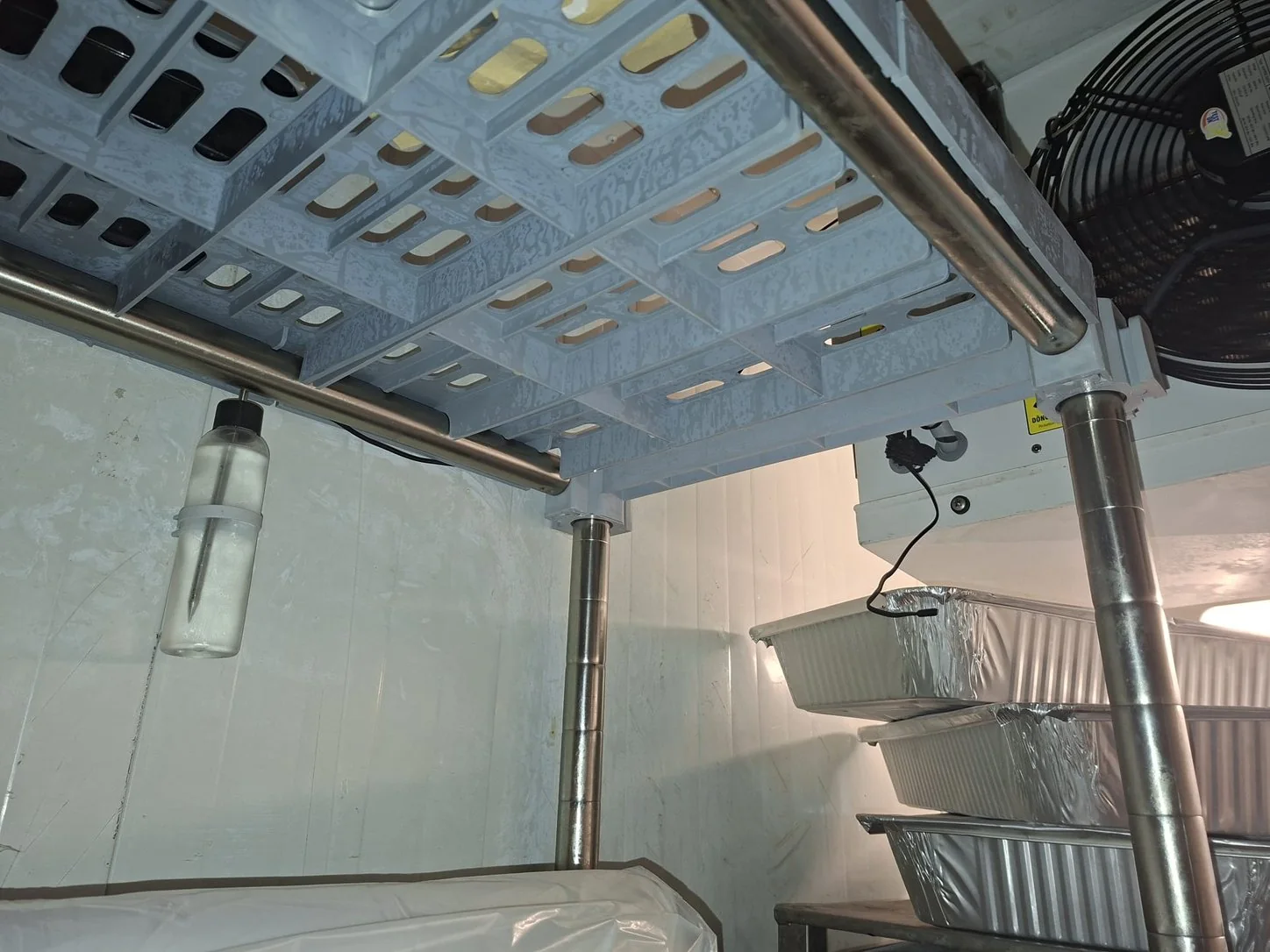
What the business owner really cares about is the temperature of the product, not the air around it. A sensor inside a sealed glycerin bottle warms and cools at a rate close to that of the product: glycerin is dense, and at the volume used it changes temperature slowly, like the stock. A door opening doesn't move it. A unit that has stopped cooling does.
← Why an air temperature sensor isn't enough, and what a glycerin bottle is
2. A generic threshold instead of a per-unit threshold
A meat refrigerator, a vegetable refrigerator and a deep freezer don't behave the same way. Even two refrigerators of the same model behave differently, depending on load, location and how often they're opened. A threshold set as a single value for all units will be too tight on some and too loose on others.
The right approach is to set the thresholds after installation, based on the behavior observed in the unit itself, and to record them in a document the customer receives. That way the threshold reflects this particular refrigerator, not an industry average.
3. Instantaneous readings with no averaging
Even a product sensor sees small fluctuations. A system that alerts on every single reading that crosses the threshold will also alert on measurement noise. A temperature alert based on an average over a few minutes filters out the fluctuation and keeps the trend.
Comparison table
| Air sensor, generic threshold | Product sensor, per-unit threshold | |
|---|---|---|
| What is measured | Air temperature in the compartment | Product temperature, via a glycerin bottle |
| Normal door opening | Alert | No change at the sensor |
| Loading warm stock | Alert | Slow rise, usually within range |
| Defrost cycle | Sometimes an alert | Visible on the chart, no alert |
| Unit that stopped cooling | Alert, after a delay | Alert when the product starts to rise, and the evaporator sensor shows it even earlier |
| Who sets the threshold | Default value | NITARTI, at the end of installation, per unit |
| What the team learns | To ignore | To respond |
How it's built in the NITARTI system
The product sensor sits inside a glycerin bottle placed in the refrigerator.
Temperature alerts are based on an average of about ten minutes, by design. That way, a normal door opening doesn't trigger a temperature alert.
NITARTI sets the thresholds at the end of installation, based on the behavior observed in the unit. The values are recorded in the installation summary the customer receives. The customer may change a threshold value in their account, and NITARTI records the value it set.
Door status is a separate signal. In a unit with a door sensor, a door left open triggers a door alert, not a temperature alert. That way the customer knows what happened, not just that something happened. The time after which the door alert is sent is agreed with the customer, and can be changed.
The evaporator sensor shows that the unit has stopped cooling even before the product temperature moves. An alert like that isn't a false alarm, even if the stock is still fine: it arrives early, and it's accurate.
Measurement accuracy: ±0.5°C.
And if there's no signal from the unit: the system detects on the server that the signal has stopped arriving, and by default sends a loss-of-monitoring alert after five minutes. The alert goes to the same channels the customer chose for temperature alerts.
What happened at a real customer
An active customer with eight refrigerators. In the first two days after installation, the system sent four genuine alerts about rising temperature, all from the same cause: a door left open. The customer had no idea it was happening at their site.
Four alerts in two days is a lot. But not one of them was a false alarm, and each came with a clear action. That's the difference between noise and information.
What the system doesn't promise
No monitoring system is entirely free of false alarms. The goal is to reduce them until every alert is worth a response, not to eliminate them. Per-unit thresholds, averaging and product measurement reduce them. They don't eliminate them.
No fault prediction. The system alerts when a value crosses the threshold set for the unit. It doesn't predict when a component will fail and doesn't give a time frame.
No refrigerant leak detection, no defrost measurement and no humidity sensor. What isn't measured doesn't trigger an alert.
Questions and answers
What counts as a false alarm in refrigeration monitoring?
An alert about a deviation that didn't put the stock at risk: a door opening, warm stock being loaded or a defrost cycle that an air sensor interpreted as a temperature rise.
How do you reduce false alarms without missing real alerts?
Change what you measure, not how high the threshold is. A product sensor instead of an air sensor, averaging over a few minutes, and a threshold set according to the unit itself. A higher threshold cuts false alarms and, to the same degree, delays the real alert.
A product sensor reacts slowly. Doesn't that delay the alert?
If the product hasn't warmed up, there's no damage. And at the same time, the evaporator sensor shows that the unit has stopped cooling before the product temperature rises, so the alert arrives early and it's accurate.
Who sets the alert thresholds?
NITARTI, at the end of installation, based on the behavior observed in the unit. The values are recorded in the installation summary the customer receives. The customer may change a threshold value in their account, and NITARTI records the value it set.
Where do the alerts go?
To the channels the customer chose: SMS, email and app notification. The customer chooses the channels and recipients, and NITARTI configures them in the system.
Want to see this on your own equipment?
We'll set you up with a live demo and show you what the measurements look like on your units.
Request a demo